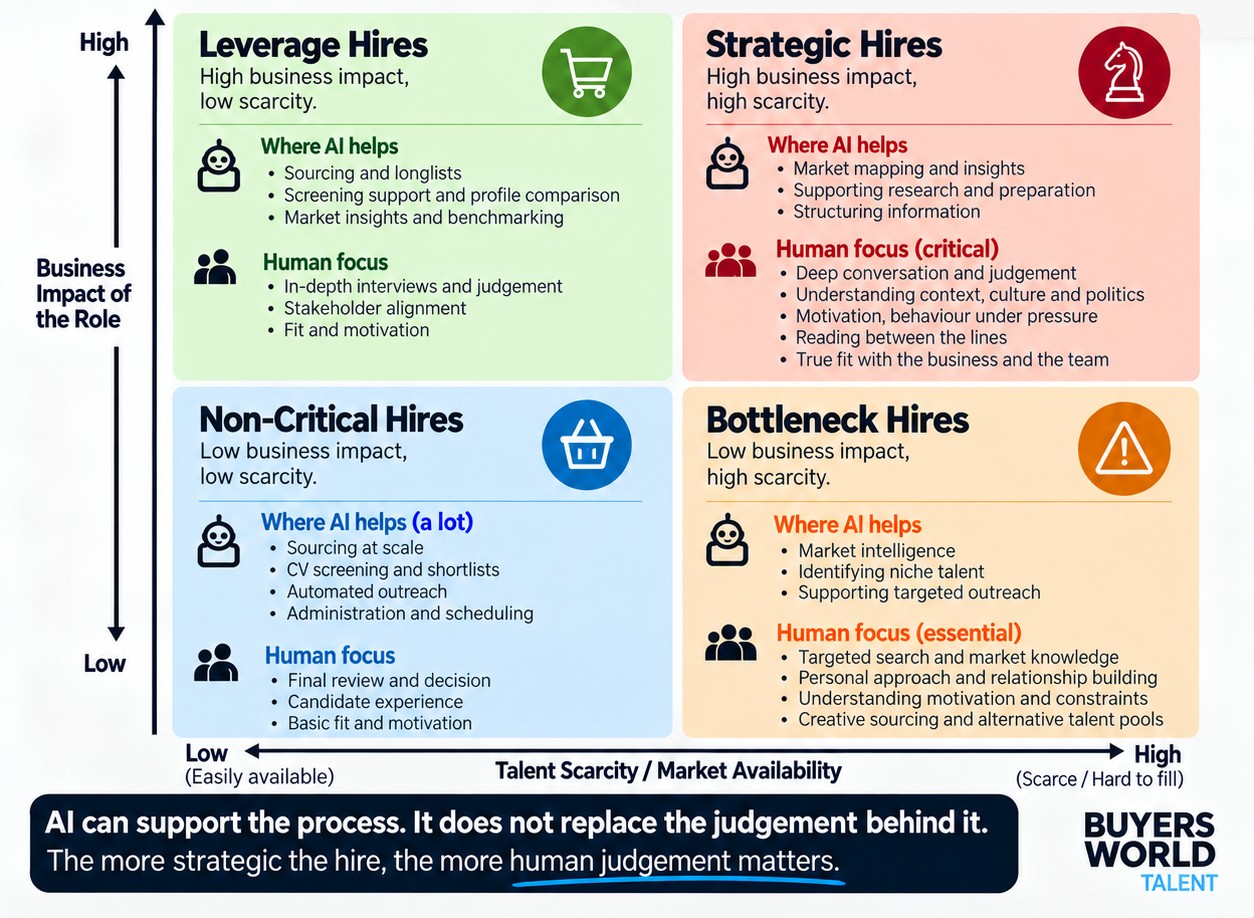
Best filled in together. Talent acquisition or HR with the hiring manager. If nobody can answer a question, that is usually the first thing to clarify about the role.
· Main category
Think of the most critical category or package this person will own. Which description fits best? The options sit where they sit on the Kraljic matrix.
· Portfolio mix
A leadership role owns several categories at once. Roughly how is the spend this person is responsible for divided over the four quadrants?
· Role scope
The category decides what kind of buyer you need. The scope decides how senior that buyer has to be.
Your quick read is ready.
The level and the hire implications are on the right and below. Answer 13 more questions to unlock the capability profile, scarcity and time to fill, the talent pool and the checks on your brief.
· Profit impact
Sharpen the position of the main category. How much does it matter to your margin and your product?
· Supply risk
How hard is that category to secure? Supply risk decides how specialised the person needs to be, and how scarce they are.
· Organisation & market
The same title asks for a different person in a function that still has to be built, in project work, or in a scarce sector.
Your full advice is ready.
Everything below now uses all your answers. Change any answer and the advice updates.
The full read
What this role actually requires
Unlock the full advice
Step 2 adds 13 questions on the category, the organisation and the market. It unlocks:
- Capability profileeight skills at the level this role needs
- Scarcity and time to filland the hiring route that fits
- Target talent poolwhich profiles to approach and where they sit
- Checks on the briefwhere your answers pull in different directions
02Capability profile
03Scarcity in the market
How many people can genuinely do this, and how reachable they are.
Low
Moderate
High
Very high
- Indicative time to fill
- Recommended route
04Salary & market read
Pay for the same level differs by country, region and sector, so a single number would mislead you.
What does an L4 Category Manager cost in your region, and will they move for your offer?
Send me the role and I come back with the salary range in your market, what candidates are paid today and what it takes to move them.
Request a market read05Target talent pool
Where the people who can do this sit today, including the ones who are not looking.
Profiles to approach
Where to look
06Checks on the brief
Where the answers pull in different directions. These are the points I would raise on a first call.
Next step
Send me this role. Get a market read in a week.
The advisor tells you what the role needs on paper. I tell you what the market will give you for it. Send the result and within a week you get the salary range for this level in your region, and what the market looks like for this role. At no cost.
Book 15 minutes
or email maurice@buyersworldtalent.com
Looking for your next step? Introduce yourself as a candidate →
The framework behind it
Six levels of procurement seniority
Category characteristics inform talent requirements. They do not determine job titles: one company's Senior Buyer is another's Category Manager. Titles regularly over- or understate the work: a "Head of Procurement" with a team of four, a "Senior Buyer" who owns a regional category strategy. The advisor therefore scores what the role must do, then maps that to a level, to the four bands of the CIPS Global Standard and to the NEVI and CIPS qualifications usually seen at that level. Experience ranges were cross-checked against the careers of 49 procurement professionals in industry, engineering and services. The level your answers point to is highlighted.
| Level | Typical titles | Experience | What the role does | Decision rights | CIPS Global Standard | NEVI · CIPS |
|---|
80%
Role scope sets the level
Mandate (30%), people leadership (20%), reporting line and geography (15% each), spend under management and organisation size (10% each). This is what separates a Buyer from a Head of Procurement, whatever the category.
10%
Kraljic sets the type
The matrix shapes the capability profile, the talent pool and scarcity, and adds to the level through its stronger axis. Strategic spend carries a premium. Portfolio roles use the spend-weighted mix of all four quadrants.
10%
Building adds a premium
Where procurement is still basic or absent, the person has to build processes and credibility from scratch. That asks for more seniority than running an established function.
How the model was set and checked
The model was fitted on 58 roles: 25 reference roles defined by Buyers World Talent and 33 anonymised real roles from the careers of procurement professionals. Leave-one-out validation on those 58 gave 74% on exactly the right level. It was then tested, without any further tuning, on 37 current procurement vacancies from the Netherlands, Belgium, Germany and Portugal, from operational buyer to CPO: 70% exact and 100% within one level, with misses in both directions. The quick read in step 1 (main category plus six scope questions) placed the vacancies as accurately as the full version, 27 of 37 exact, provided the main category is chosen correctly; step 2 adds the advice around the level, not a different level. Every role below runs through the live model, misses included.
Show all 95 roles
| Reference role | Set | Kraljic | Expected | Model | Index |
|---|
The advisor works for any country: seniority, capabilities and scarcity follow from the work, not the location. Salary is left out on purpose, because it only means something for a specific region; ask for a market read for that. Time-to-fill ranges assume a direct approach of passive candidates. Supply risk and profit impact use the classic Kraljic axes; the capability profile adds the supplier's view (being a customer of choice) and ESG, in line with the current CIPS Global Standard. Qualification levels follow the NEVI and CIPS programmes; MCIPS requires the CIPS Level 4–6 route plus three years in a position of responsibility. They show what is usually seen at a level, not a requirement: in the Dutch careers we checked, about half of the people at Category Manager level and above hold NEVI 2, and CIPS is more common outside the Netherlands. Your answers stay in your browser unless you choose to send them.